Building Your Village – and Why It Still Matters
People say it takes a village.
What they don’t tell you is that sometimes you have to build it yourself.
In 2008, my wife and I, along with two other parents, realized the support we needed for our children did not exist in a practical way. Public outings were stressful. Structured social opportunities were limited. Parents felt isolated. Our children were often on the margins.
So we started small.
Four families formed a nonprofit 501(c)(3). The goal was not prestige. The goal was participation.
And it grew.
More families joined. More children participated. The village expanded because the need was real.
Visibility Builds Confidence
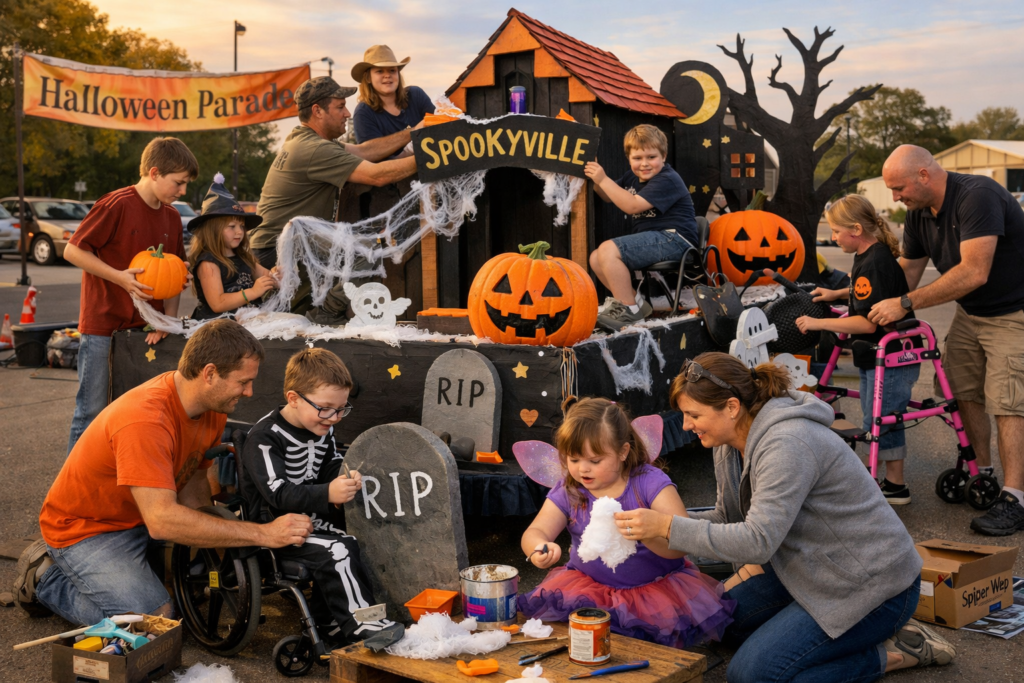
We entered Halloween parades together. Built floats. Handed out candy to the public.
Why does that matter?
Because visibility changes identity.
When children with special needs participate publicly, they move from being “accommodated” to being contributors.
That shift is strategic, not sentimental.
Movement Changes the Brain
We raised funds so families could participate in Special Warriors, a local strength-training program for individuals with special needs.
The results were immediate.
Anxiety at the beginning of a session often melted within ten minutes of purposeful strength training. Gross motor activity engages the brain. Endorphins increase. Dopamine stabilizes. Regulation improves.
This wasn’t just exercise.
It was neurological organization.
That insight changed how we viewed behavior. It taught us that structure and movement can be intervention.
Communication Changes Dignity
We helped families acquire iPads for augmentative communication.
Communication is not a luxury. It is infrastructure.
When a child can express needs, preferences, and thoughts, family systems stabilize.
This isn’t emotional language — it’s strategic.
Contribution Builds Adulthood
Before Thanksgiving, our families shopped together for food bank donations. At Christmas, we delivered gifts in person.
Our children were not passive recipients of services.
They were contributors to their community.
That matters long term.
Because adulthood requires identity.
Identity forms through participation.
⸻
Why This Matters Now
Our children are now adults.
The nonprofit served its season. We closed it with gratitude.
But the experience taught us something crucial: while we successfully built community for our children, we discovered a massive gap in what comes next.
Here is what we learned:
Community cannot be accidental.
Structure must be intentional.
And mistakes in early planning echo loudly in adulthood.
There are many conversations about raising young children with special needs.
There are far fewer about:
• Supporting adult independence
• Navigating funding systems
• Structuring long-term financial protection
• Preventing burnout in caregivers
• Designing sustainable community participation
That gap in adult support is exactly why we created Brownies’ Universe — to build that next village.
Not through sentiment.
Through shared experience, extracted lessons, and practical structure.
Storytelling is how we remember.
Strategy is how we protect.